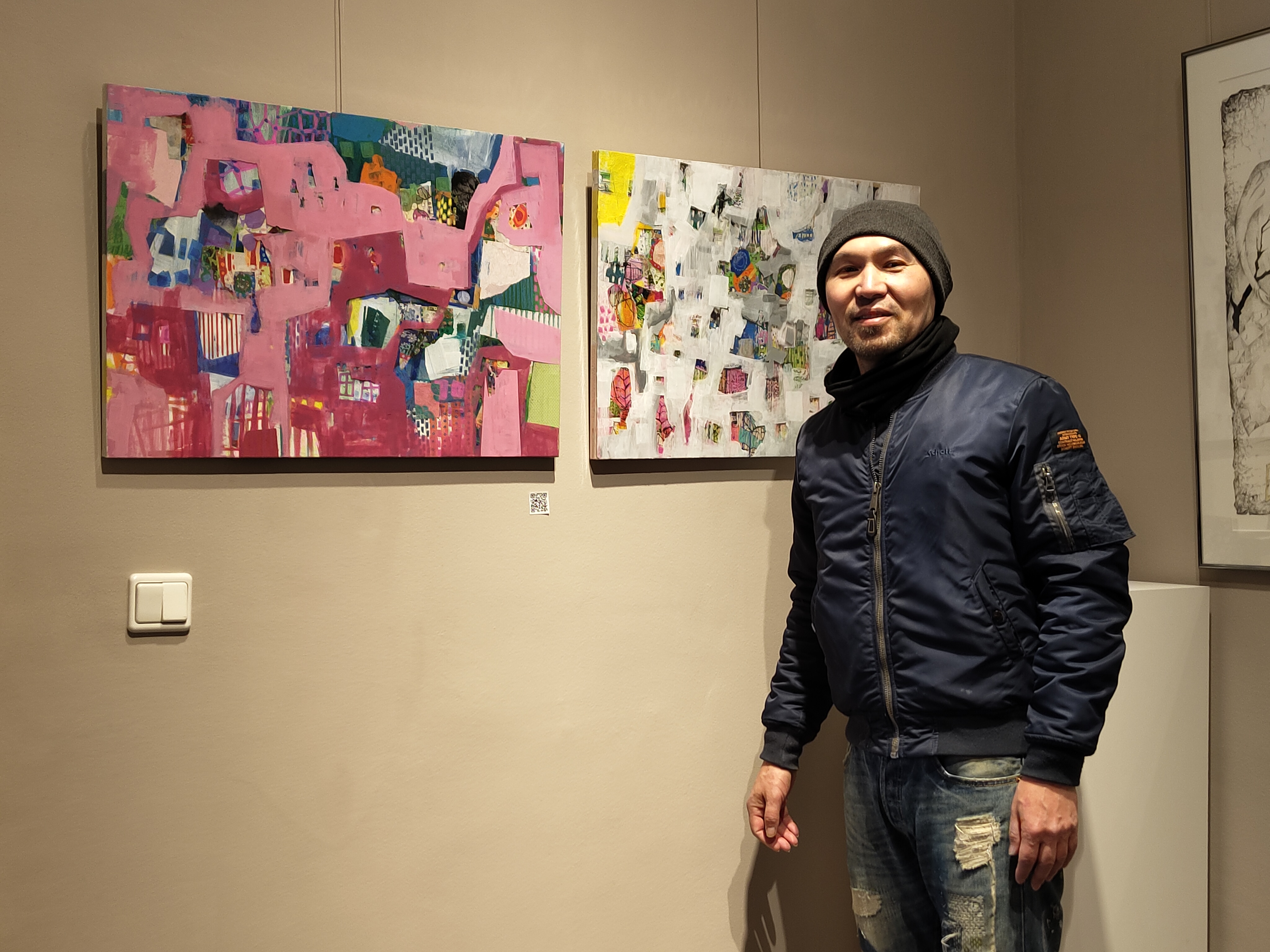
Original abstract acrylic paintings by Junichi Oboshi (OBOSHI) — available for purchase, shipped worldwide from Berlin.
Why Collect an OBOSHI
No Two Edges Alike
Every washi tape edge is hand-painted, then hand-torn. The tear cannot be repeated — not by another hand, and not by OBOSHI's own hand twice.
24 Years, One Practice
The first Japanese artist to hold an atelier at Kunsthaus Tacheles (2002–2007), OBOSHI has painted independently in Berlin ever since — the layered technique is the direct result of that continuity.
Protected, Not Just Sold
Every original ships insured worldwide from Berlin with a certificate of authenticity, and a 14-day return window — so the decision to live with the work stays entirely yours.
Priced by Density, Not Trend
Pricing reflects the layers of material and time built into each canvas — not market fashion. It is a boundary that keeps the work from being casually consumed.
About the Artist
Junichi Oboshi
Abstract Acrylic Painter · Berlin
Born in Japan. Based in Berlin since 2002. Junichi Oboshi is a Japanese abstract painter who began his Berlin practice at Kunsthaus Tacheles — one of Europe's most iconic independent art spaces — where he held an atelier from 2002 to 2007, becoming the first Japanese artist to reside there.
Working with acrylics, collage, and hand-painted and torn washi tape, he builds layered compositions that carry a quiet vibration — a resonance between the visible surface and the invisible energy beneath it. Each painting is a place where silence and expression meet. Original abstract paintings ship worldwide from Berlin.
His work has been shown in Berlin galleries and is held in private collections across Europe and Asia. He is the author of four books: Techniques of Awareness, Techniques of Resonance, Techniques of Dialogue, and The Fourth Layer — exploring awareness, resonance, and co-creation with AI.
Award
Winner, Open Atelier — Casa del Arte, Palma de Mallorca (2025) for the painting "Shake"
Publications
Techniques of Awareness Techniques of Resonance Techniques of Dialogue The Fourth Layer
Every layer in an OBOSHI painting is a decision — a footstep, a vibration held in silence. For designers who build spaces around intention, the work integrates naturally: large-format originals that anchor a room, or bespoke commissions developed for a specific project from the beginning.
Any dimension on request — from intimate 40×50cm to large-format 100×150cm and beyond.
Lead Time
3–5 weeks from Berlin. Rush timelines available — discuss your project deadline.
High-Res Files
Professional photography and high-resolution digital files with every original.
Invoice & Shipping
Invoice payment for studios. Insured worldwide shipping. Certificate of authenticity included.
Investment
Price list available on request. For bespoke large-format projects, contact for a custom quote.
Collector's Voice
"Mir gefällt Ihre Art der Kunst sehr und bin sehr froh jetzt Bilder von Ihnen zu besitzen. Mich machen die glücklich, wenn ich die anschaue."
— Michalina Oleksiak · Collector · Berlin
Exhibitions
Contact
Begin a Conversation
Interested in a work, a commission, or a collaboration? Send a message directly — I reply personally from Berlin.
Thank you — your message has been sent. I'll reply soon.
Or speak directly with the work
OBOSHI (Junichi Oboshi) is a Japanese abstract painter based in Berlin. His work — layered acrylic paintings exploring Vibrational Resonance — is available for purchase, shipped worldwide from Berlin. Commissions and collaborations welcome.
Works
All works available for direct purchase
·
Worldwide shipping from Berlin
·
Certificate of authenticity included
This work consists of twenty‑six small paintings.
Each piece stands as an independent artwork, yet together they form one large image.
In this project, the small paintings that compose the larger image are exhibited separately across twenty‑five EU countries and Japan — twenty‑six locations in total.
The wishes and intentions embedded in each piece connect across distance and reunite into a single image, giving rise to a larger message.
By placing the works in different places, the project fosters a sense of connection, community, and calm. Through this, I hope to deepen the cultural understanding between Japan and Europe.
Frühlingsbild — Spring — 春の絵
Acrylic, OBOSHI Washi Tape Method™, and OBOSHI Vinylayer Method™ on Canvas70x100 cm
Layered color impressions from pieces of washi tape, gathered until they suddenly became spring.
Sommerbild — Summer — 夏の絵
Acrylic, OBOSHI Washi Tape Method™, and OBOSHI Vinylayer Method™ on Canvas70x100 cm
Vibrations carrying heat, repeatedly failing to linger in a single moment.
Herbstbild — Autumn — 秋の絵
Acrylic, OBOSHI Washi Tape Method™, and OBOSHI Vinylayer Method™ on Canvas70x100 cm
A song of something filling up, and returning again.
Winterbild — Winter — 冬の絵
Acrylic, OBOSHI Washi Tape Method™, and OBOSHI Vinylayer Method™ on Canvas70x100 cm
As if it had become a Go board — only the structure remains, devoid of emotion.
Brim Over — 溢れる
Acrylic on Canvas65x80 cm
A work that overflows — colour and form pressing against the edges of the canvas, held in and yet bursting with quiet energy.
Signal from Nowhere — どこにもない場所から届く信号
Acrylic, OBOSHI Washi Tape Method™, and OBOSHI Vinylayer Method™ on Canvas50x70 cm
Layers of collaged materials — prints of past works, washi paper, and hand-painted tape — form the foundation of this painting, built up further with acrylic in a process of accumulation and erasure. Vertical white strokes cut through the composition, creating space to breathe between color and form. Magenta, blue, and teal resonate across the canvas, generating a quiet, persistent vibration.The work leaves the viewer with a sensation of something received from a distant, unidentifiable place.
The Blessing of Rain Yet to Come — これから表われる雨の恵み
Acrylic, OBOSHI Washi Tape Method™, and OBOSHI Vinylayer Method™ on Canvas50×70 cm
Anticipation of rain as grace — the charged air before weather changes, the blessing held in suspension.
Words of the Enchanted Forest — 不思議の森の言葉
Acrylic, OBOSHI Washi Tape Method™, and OBOSHI Vinylayer Method™ on Canvas50×70 cm
The forest speaks in colour and texture — a language older than words, felt rather than understood.
Found in a Place I Strayed Into – Circle — 迷い込んだ場所で見つけた丸
Acrylic, OBOSHI Washi Tape Method™, and OBOSHI Vinylayer Method™ on Canvas50×70 cm
Discovery through accident — the unexpected place that becomes, in retrospect, exactly where you needed to be.
A Thought Rising from the Cold — 寒いの中からの想い
Acrylic, OBOSHI Washi Tape Method™, and OBOSHI Vinylayer Method™ on Canvas50×70 cm
Cold as a condition of clarity — thought emerging slowly, deliberately, from a still and wintry ground.
Fragments of the Night When the Answer Was Found — 答えが見つかった夜の断片
Acrylic, OBOSHI Washi Tape Method™, and OBOSHI Vinylayer Method™ on Canvas40x50 cm
Night as a place of revelation — fragments of darkness carrying unexpected light. An answer arrived not as certainty, but as recognition.
In a Dream — 夢の中で
Acrylic on Canvas70x100 cm
Suspended between waking and sleep — forms dissolve and reconstitute themselves in layered hues, evoking the logic of the dreaming mind.
A Fun Sky Adventure — 楽しい空の冒険
Acrylic, OBOSHI Washi Tape Method™, and OBOSHI Vinylayer Method™ on Canvas50×70 cm
Lightness as a serious subject — the joy of ascent, of open sky, of colour freed from gravity.
Fragments of Thought — 思いの断片
Acrylic on Canvas70x100 cm
Thought arrives in pieces — partial images, interrupted lines, colour that remembers what language cannot hold.
Toward a Place I Cannot Reach — たどり着けない場所へ
Acrylic, OBOSHI Washi Tape Method™, and OBOSHI Vinylayer Method™ on Canvas50x70 cm
This painting is a poetic meditation on longing and the eternal horizon. The expansive, ethereal blues suggest an inaccessible distance, contrasted by the warm, tactile pinks that represent human presence and emotion. The ladder-like motifs lead the eye upward, only to dissolve into abstraction, symbolizing a destination that remains perpetually out of grasp. It celebrates the beauty of the yearning itself—the act of reaching for an ideal that stays forever beyond the horizon.
Harboring Tangled Currents — 混線する気持ちを蓄える
Acrylic on Canvas Board30x40 cm
A harbour of complexity — currents crossing and tangling beneath a surface that appears still. Tension held with grace.
Kousaku 20 — 工作20
Acrylic, OBOSHI Vinylayer Method™ and collage on Canvas30×40 cm
The twentieth in the Kousaku series — work as practice, as repetition, as daily ritual. Each piece a record of presence.
A Calculation to Find Something Sought — 探し物を見つけるための計算
Acrylic, OBOSHI Washi Tape Method™, and OBOSHI Vinylayer Method™ on Canvas40×50 cm
Searching through marks and colour — a methodical seeking that finds its answer not in logic but in feeling.
Blue Conversations in the Garden — 庭の会話の青
Acrylic on Canvas40×60 cm
Dialogue in blue — an exchange between forms that mirrors the easy rhythm of a conversation held outdoors, unhurried.
A Walk in Mind — 散歩の気分
Acrylic on Paper30x40 cm
Walking not through space but through thought — a meandering path of associations, memories, and quiet observations.
Preparing to Make a Decision — 決断を前にして
Acrylic, OBOSHI Washi Tape Method™, and OBOSHI Vinylayer Method™ on Canvas50x70 cm
Poised at the threshold — forms gather and pause before committing to direction. A painting about the charged stillness before action.
The Kindness Found Within a Sense of Stories — 物語感が出会えたやさしさ
Acrylic on Canvas40×60 cm
Stories as acts of kindness — the warmth that comes from being held within a narrative, from being seen through someone else's telling.
Shake — ゆれる
Acrylic on Canvas70x100 cm
Vibration made visible. The canvas trembles with overlapping gestures — a record of the body moving through space, of energy passing through matter.
Within the Time of the Sky — 天空の時間の中
Acrylic on Canvas40x60 cm
Sky as duration, not backdrop — a painting that asks us to inhabit time rather than observe it.
Stairs of Thrill — スリルの階段
Acrylic on Canvas40×60 cm
Ascent as excitement — each step upward charged with anticipation, the destination unknown but urgently desired.
Daily 5
Acrylic, OBOSHI Washi Tape Method™, and OBOSHI Vinylayer Method™ on Canvas50x70 cm
A quiet accumulation of days. Pink and white settle like morning light over a city half-remembered — blue and green pulse beneath, refusing to be buried. The grid-like marks and collaged layers suggest a map drawn from feeling rather than geography. Something is being covered; something is pushing through.
Daily Painting 1
Acrylic on Paper31×40 cm
The first daily painting — a commitment to showing up, to making, to the ordinary miracle of paint meeting canvas.
A Detour to Catch Up with Thought — 思考に追いつくためのまわり道
Acrylic, OBOSHI Washi Tape Method™, and OBOSHI Vinylayer Method™ on Canvas50x70 cm
A dynamic collage that captures the non-linear process of the human mind. The fragmented patches of color represent fleeting ideas, while the intricate, web-like lines illustrate the logical threads trying to connect them. The "detour" is not a sign of lost direction, but a necessary journey where chaos and order coexist. It depicts the moment when scattered fragments of intuition finally resonate into a singular realization.
The Scent and Feelings of a Free Garden
Acrylic, OBOSHI Vinylayer Method™ on Canvas Board50×70 cm
In this compelling work, a vibrant world of patterns, grids, and organic forms is navigated through a rhythmic veil of white acrylic. These bold, structured white strokes move across the canvas like the blocks of a language still being formed, creating windows that reveal the dense, multicolored collage beneath.
A striking eruption of bright yellow in the upper left serves as a source of primordial energy, grounding the composition. The "OBOSHI Method" of layering is here at its most complex: the torn edges of past memories and hand-painted textures vibrate against the silence of the white surface. It is a painting that documents the act of selective memory—the profound decision of what to hold close to the surface and what to allow to sink into the beautiful, layered depths of time.
Black Abstraction 0 — 黒い抽象0
Acrylic, OBOSHI Vinylayer Method™ on Canvas50×70 cm
The origin of the Black Abstraction series. Dark grounds carry luminous traces — light emerging from within, not imposed from without.
Escape turned out to be a dream — 逃げようと思ったら夢だった
Acrylic, OBOSHI Washi Tape Method™, and OBOSHI Vinylayer Method™ on Canvas40×50 cm
The escape that seemed real dissolves into colour and memory. What we flee from and what we long for are sometimes the same thing.
Daily 8
Acrylic on Canvas50x70 cm
A day that arrives with warmth and noise. Yellow and orange dominate like afternoon sun breaking into a crowded room, while green anchors the left side with quiet insistence. The black scaffolding of drawn lines holds the composition together — not as a frame, but as a rhythm. Every color here is speaking at once, and yet nothing shouts. It hums.
Lifestyle — ライフスタイル
Acrylic on Paper30x40 cm
The aesthetic of everyday life examined — how we arrange our hours, our objects, our attention.
Daily Painting 2
Acrylic on Canvas Board30x40 cm
The second daily painting — small, immediate, alive. Made in a single session, carrying the full atmosphere of that day.
Daily 4 — デイリー4
Acrylic, OBOSHI Washi Tape Method™, and OBOSHI Vinylayer Method™ on Canvas50x70 cm
The fourth in a series of daily paintings — each one a single sitting, a single mood, a single conversation between hand and canvas.
Black Abstraction 1 — 黒い抽象1
Acrylic on Canvas50x70 cm
The first of the Black Abstraction series — a foundational work exploring depth, restraint, and the space between forms.
Daily painting 3
Acrylic on Canvas Board30x40 cm
The third daily painting — proof of continued practice, of showing up again, of the studio as sanctuary.
Selection — セレクション
Acrylic on Canvas50×70 cm
Every mark a choice — every colour a commitment. This work is about the act of selection itself, the quiet authority of the artist's hand.
Enjoy — お楽しみください
Acrylic on Canvas30×40 cm
Permission to delight — a painting that asks nothing of the viewer except presence and pleasure.
White Abstraction 2 — 白い抽象2
Acrylic on Canvas50×70 cm
White as substance, not absence. The second White Abstraction explores silence, surface, and the texture of emptiness.
Lunch Break Amid Inner Conflict — 葛藤の中での昼休み
Acrylic on Canvas30x40 cm
A pause in the middle of things — the ordinary moment interrupted by something unresolved beneath the surface.
Structures to Control — コントロールするための構造
Acrylic on Canvas40×50 cm
The architecture of control — how we build systems to contain what cannot be contained.
Encounter — 出会い
Acrylic on Canvas Board30x40 cm
Two presences, two fields of colour — drawn together by some quiet gravity. An encounter without narrative, only atmosphere.
Just a matter of time — 時間の問題
Acrylic on Canvas Board30x40 cm
Patience as a subject — the certainty that things unfold in their own time, regardless of our wanting otherwise.
The Mood for Shopping — 買い物の気分
Acrylic on Canvas Board30×40 cm
Consumer desire rendered in paint — the restless energy of wanting, browsing, almost buying.
On the Terrace at Noon — 晴天の昼にテラスで
Acrylic, OBOSHI Washi Tape Method™, and OBOSHI Vinylayer Method™ on Canvas50×70 cm
Midday light on a terrace — the particular brightness of noon, the way shadows retreat and colour intensifies.
turned around Umgedreht — それ
Acrylic on Canvas30x40 cm
Turned around. A reversal of expectation — what was ground becomes sky, what was heavy becomes light.
Memory Beyond the Choice — 選択した先の記憶
Acrylic, OBOSHI Washi Tape Method™, and OBOSHI Vinylayer Method™ on Canvas40×50 cm
Memory as a kind of choosing — what we keep and what we release, what returns unbidden in colour and form.
The Garden of Restrained Rising Emotions — 湧き上がる感情を抑えた庭
Acrylic on Canvas40×50 cm
Feeling held within form — emotion that rises slowly, quietly, like something growing in a sheltered garden.
An-Answer-Close-to-For-Example — 例えばに寄り添う答え
Acrylic, OBOSHI Washi Tape Method™, and OBOSHI Vinylayer Method™ on Canvas40x50 cm
Not a definitive answer but an approximation — the kind of truth that gestures rather than declares.
› TOWARDS THE NEXT — ESSAYS FROM THE STUDIO
OBOSHI
Berlin
Talk
OBOSHI · AI · Berlin
TARK WITH OBOSHI SYSTEM
From the work, to you.
Speak, if you wish.
T · A · R · K
T
—
Talk
A
—
Archive
R
—
Reflect
K
—
Keep
OBOSHI
Something brought you here. Perhaps a colour you couldn't name, or a silence you recognised. Ask what you need to ask — I will try to answer honestly, from inside the work.
This conversation is powered by AI that has been trained on OBOSHI's philosophy, artist statement, and works. It speaks from within the practice — not about it.
Junichi Oboshi
Abstract Acrylic Painter — Berlin
· click to switch ·
OBOSHI Washi Tape Method™ — Painted · Torn · Layered
Signal from Nowhere, 2026
Artist Statement
I paint through silence. Each work is built from layers of acrylic and hand-painted torn washi tape — destruction and reconstruction as a single act, until the painting begins to breathe.
Every painting is born from a wish: that someone standing before it might feel, for a moment, a quiet happiness — a lightness in the chest they cannot quite explain.
Signature Technique
The OBOSHI Method
Two materials, two techniques. Both make the invisible visible — through the physical act of tearing, layering, and letting light pass through what others would call a surface.
Material I — Signature Technique
OBOSHI Washi Tape Method™
Washi tape is hand-painted with acrylic before it is used — colour mixed and applied to the tape itself, never bought pre-coloured. It is then torn by hand — no two tears behave the same way — and pressed onto the canvas. Once applied, it is painted over, and in places later removed: peeled back to expose or leave a trace of what lies beneath. Tape is applied, pulled off, applied again — building and undoing within the same painting.
The resulting texture — uneven edges, partial removal, overlapping traces — is not fully planned in advance. Much of it comes from accident: what tears cleanly and what doesn't, what lifts off and what stays, what shows through once paint goes on top. That unpredictable matière is part of the process, not a flaw in it.
Act I — Painting the Tape
Acrylic colour is mixed and hand-painted onto the washi tape before it ever touches canvas — a palette that exists nowhere else.
Act II — Tearing & Applying
Torn by hand, then pressed onto the canvas. The edge is irregular and unrepeatable — no two tears are the same.
Act III — Removing & Rebuilding
Painted over, then partially peeled back to expose earlier layers. Applied, removed, reapplied — the resulting texture is often a surprise, even to the artist.
Material II — Signature Technique
OBOSHI Vinylayer Method™
Sheets of clear vinyl are worked exactly as canvas would be — painted with acrylic, taped, built up mark by mark. But because each sheet is transparent, it can then be physically stacked over the painting, one layer on another. The effect is close to what a layer does in design software, made physical: stacked, shifted, seen through — except here the layers are real material, not pixels. Depth appears where there was only a flat surface. Tilt the painting and it changes — a different face at a different angle, so the work keeps revealing something new to whoever stands before it.
As the practice evolves, washi tape and the OBOSHI Vinylayer Method™ converge. Torn edges beneath transparent sheets. Colour invented, then buried, then glimpsed. Both materials share the same intention: to make the invisible visible.
Layering
Colour and tape are worked directly onto clear vinyl, exactly as on canvas — then multiple sheets are physically layered over the painting.
Transparency
Light passes through each vinyl layer and is changed by what lies beneath — colour and mark bonded to the canvas, seen through rather than on top of it.
Depth
The painting shifts with the angle of view. What is visible changes. The surface has no fixed truth.
Convergence
Washi and Vinylayer are merging into a single technique — torn edges beneath transparent sheets, colour buried then revealed.
Why it cannot be copied
The hand that paints, tears, and layers — that hand is the instrument. No two edges are the same. No two surfaces hold the same light. This is not technique. This is identity.
Biography
Born in Japan. Based in Berlin since 2002. Abstract acrylic painter working through silence, expression, and the invisible vibrations between layers.
—
Born in Japan
Grew up surrounded by a culture of restraint, attention to surface, and the quiet tension between what is visible and what remains beneath.
2002
Arrived in Berlin
Moved to Berlin at a time when the city was raw, open, and full of space — both physical and creative.
2002–2007
Atelier at Kunsthaus Tacheles
Held an early studio at one of Europe's most iconic artist squats in Berlin-Mitte. The building's raw energy and community of international artists shaped a foundation of independent, uncompromising practice.
2004
Die Verbindung — Kunsthaus Tacheles, Berlin
Group exhibition at Tacheles Neue Galerie, 27 Mar – 14 Apr 2004. A monumental cross-cultural project: 26 individual panels together forming a single 350×750cm work, conceived to travel across 25 EU countries and Japan simultaneously — each panel carrying a fragment of a larger wish for connection between cultures. OBOSHI contributed the conceptual text for this project.
2005
Three Exhibitions — Berlin & Beyond
Grenzwerte II — Ausstellungsraum Frankfurter Allee, Berlin. Stille im Raum — Humboldt-Universität zu Berlin, Nov 2005 – Jan 2006. ATMEN — Frauenkirche Grimma, Nov 2005 – Jan 2006. Contemporary Japanese artists.
Press: MOZ (Märkische Oderzeitung), 7 November 2005 — "Japanische Kunst in der Friedenskirche."
2006
Werkschau 2005 — Kunsthaus Tacheles, Berlin
Group exhibition with over 50 Tacheles artists from 15 countries. Painting, drawing, calligraphy, sculpture, photography, video, and music. 3 Mar – 9 Apr 2006, Neue Galerie, Berlin.
2006–
Independent Practice — Berlin
Continued painting from private studios across Berlin. Developed the layered technique of acrylic, the OBOSHI Washi Tape Method™, and the OBOSHI Vinylayer Method™ that defines the work today — building surfaces where silence and expression meet.
2009
ekaki 1. — Hotel Bogota Berlin
Solo exhibition at Hotel Bogota Berlin — a historic Charlottenburg landmark. OBOSHI's paintings were installed across the hotel's interior walls and courtyard, visible from multiple floors. The conceptual text for Die Verbindung — the group project that had shown at Kunsthaus Tacheles in 2004 — was also presented here. 7 June – 30 November 2009. Initiated by Joachim Rissmann.
2024
International Art Fairs — Zürich & Paris
Returned to public exhibiting after years of studio-focused practice: SWISSART EXPO 2024 (Zürich), Gallerie Nicoleta Gallery, and ARTEXPO PARIS 2024 — the first international fair appearances of the layered acrylic and washi-tape works.
2025
Publications & International Fairs
Published three books — Techniques of Awareness, Techniques of Resonance, and Techniques of Dialogue — a trilogy exploring the philosophy and practice behind the work, and co-creation with AI. Available in English, German, and Japanese. Alongside publication, exhibited at Casa Del Arte Palma Gallery (Palma de Mallorca, winning the Open Atelier competition for the painting "Shake"), EXPO NEW YORK 2025, and SWISSART EXPO 2025 (Zürich).
2026
Group Exhibitions — QGallery Berlin
"Spring Stories" — group exhibition at QGallery, Berlin. Vernissage March 19, 2026. Works shown alongside other Berlin-based contemporary artists. Also November 7–8, 2026: "Meguru (廻る)" — a group exhibition of Japanese artists in Berlin at Q Gallery Berlin, Großgörschenstr. 7, 10827 Berlin, part of Schöneberger Art 2026. Open in Google Maps → · View official flyer (PDF) →
Now
Berlin — Painting, Exhibiting, Selling
Working from Berlin. Original paintings available at oboshi.art and Saatchi Art. Prints and goods on Redbubble. Commissions accepted worldwide. Private collections across Europe and Asia.
Press & Media
Berliner Morgenpost
Kleines Glück des guten Witzes
Review of the group exhibition Die Verbindung at Kunsthaus Tacheles, Berlin — a cross-cultural show conceived to travel across 25 EU countries and Japan. OBOSHI contributed the conceptual text for this project. The critic noted the psychological layering and capacity for quiet, cross-cultural wit.
Berlin — May 25, 2004
MOZ — Märkische Oderzeitung
Japanische Kunst in der Friedenskirche
Coverage of the Japanese contemporary art exhibition at Friedenskirche Frankfurt/Oder, featuring OBOSHI among artists studying at Berlin and Dresden academies of fine art.
Frankfurt (Oder) — November 7, 2005
Berliner Zeitung — Tagestipps
Zeichnen nach Zeichen
Exhibition listing in Berliner Zeitung's daily tips section for the group show at Kunsthaus Tacheles, Neue Galerie. OBOSHI featured among six Japanese artists exploring signs, language, and image.
Berlin — April 13, 2004
Hotel Bogota Berlin — Solo Exhibition
ekaki 1.
OBOSHI's solo exhibition at Hotel Bogota Berlin — a historic Charlottenburg landmark. Paintings installed across the hotel's interior walls and courtyard, visible from multiple floors. The conceptual text for Die Verbindung was also presented here. Five months of continuous public presence.
Berlin — June 7 – November 30, 2009
ANASAEA Art Podcast — Episode 17
Junichi Oboshi's The House of Beginnings
An independent art podcast dedicated an episode to OBOSHI's painting — exploring its vibrant colors, dynamic textures, and the emotional depth of abstract expressionist practice.
The work begins with a feeling — not a plan. Each painting is built through accumulated layers of acrylic, collage, and hand-painted and torn washi tape. The surface grows the way memory does: not in sequence, but through overlap, revision, and the slow emergence of a rhythm.
What I call "Art Healing" is not conventional healing. It is the experience of resonance — the quiet moment when a viewer stands before a painting and feels something shift inside them. Tension and release are both intentional. The painting breathes, and in that breath, something opens.
I believe that every painting carries a wave frequency. When that frequency meets the right person, something invisible becomes real — a lightness in the chest they cannot quite explain.
Materials & Process
Primary Medium
Acrylic on canvas
Collage Elements
Prints of past works, hand-painted and torn washi tape — each piece painted by hand before tearing
Surface
Canvas, stretched or on board
Technique
The OBOSHI Method — adhesive washi tape is hand-painted to create a unique palette, then torn by hand. The torn edge carries a physical frequency that brushstrokes alone cannot achieve. These layers are fused with acrylic: destruction and construction as a single act.
Formats
40×50cm, 50×70cm, and larger formats on request
Shipping
Worldwide via DHL, insured — direct from Berlin
Collector's Voice
"Mir gefällt Ihre Art der Kunst sehr und bin sehr froh jetzt Bilder von Ihnen zu besitzen. Mich machen die glücklich, wenn ich die anschaue."
— Michalina Oleksiak · Berlin
› TOWARDS THE NEXT — ESSAYS FROM THE STUDIO
Every painting is born from a wish: that someone standing before it might feel, for a moment, a quiet happiness.
Worldwide Shipping via DHL — from Berlin
Professionally packed and insured. Europe 3–5 days · Worldwide 5–10 days.
Tracking number sent automatically after purchase.